A Buddha hidden in plain sight
In Bangkok’s Chinatown, the story of one of the world’s most remarkable Buddha images begins with an unremarkable appearance. For decades, a large statue at Wat Traimit seemed to be made of plaster and stucco. Then, during a move in 1955, its outer shell cracked, and the gold beneath it came to light.
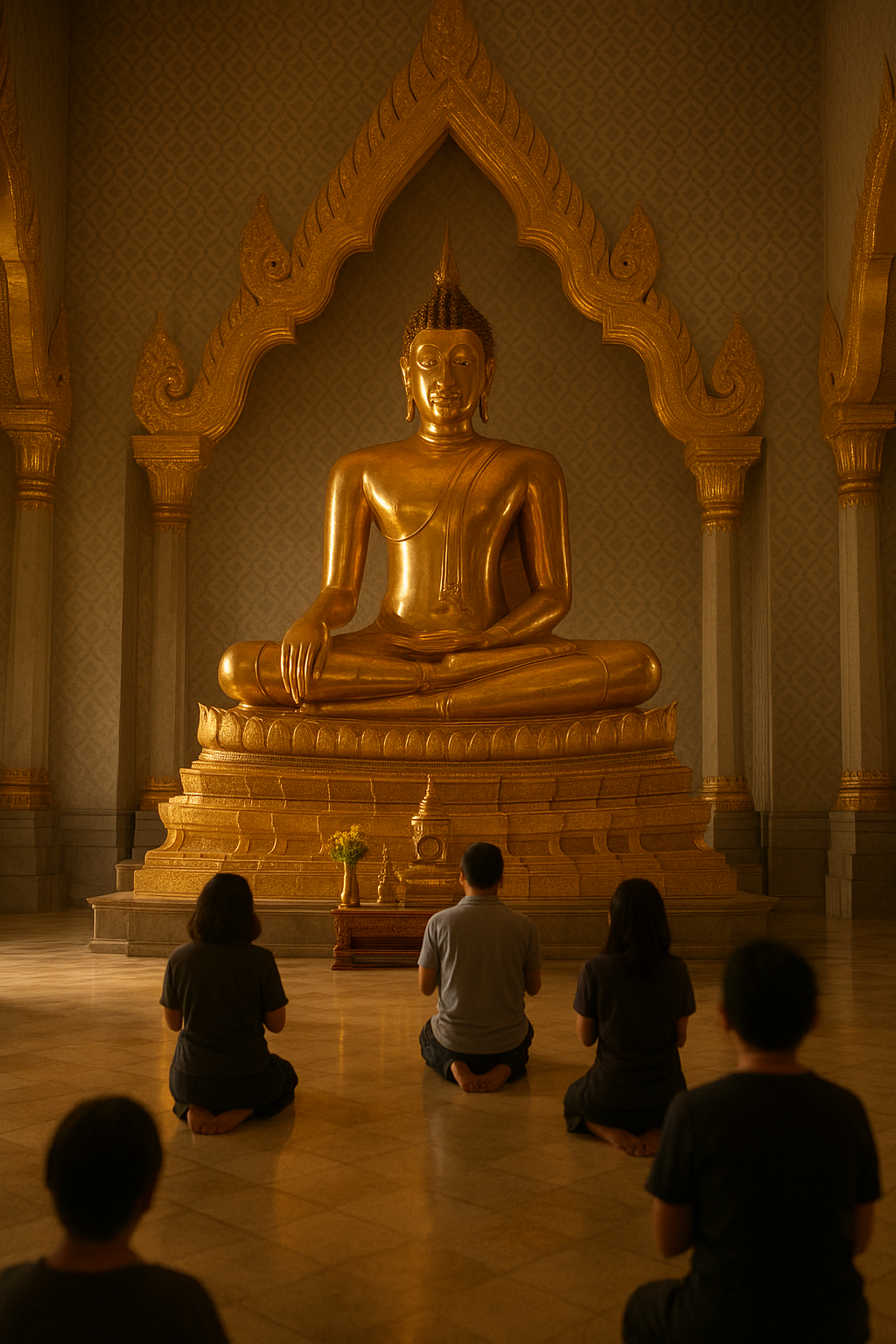
The statue, formally known as Phra Phuttha Maha Suwana Patimakon, is now celebrated as the Golden Buddha. It sits in a temple hall near Hua Lamphong railway station, just beyond the busy streets and shopfronts of Yaowarat. Around three metres tall and weighing roughly 5.5 tonnes, it is an extraordinary sight. But the image’s appeal is not only its size or its gold. It is the thought that, for years, people encountered this treasure without knowing what it was.
The story also suits Bangkok itself, a city where old and new often share the same narrow street. Around Wat Traimit, delivery carts, buses, gold shops and food stalls keep the neighbourhood in motion. Step into the temple, and the pace changes. The statue’s calm, seated form offers a pause in the middle of the city’s everyday bustle.
The day the plaster broke
The Golden Buddha is thought to have been at Wat Traimit since the 1930s, after being moved from another temple. At the time, its surface was covered in plaster, and there was no obvious reason to treat it as anything other than a substantial but ordinary Buddha image.
The turning point came in 1955, when the statue was being moved to a new building. Accounts of the discovery describe the image falling during the work, with the plaster casing cracking open. Beneath it was gold. What had looked like a plain, heavy statue had concealed a dazzling core.
It is easy to picture the surprise of that moment, but the history behind the concealment is less certain than the dramatic discovery. A popular explanation says the statue was covered to protect it from invading forces, perhaps during the conflicts of an earlier period. The disguise would have made a valuable image look much less tempting to looters. It is a compelling story, but the precise circumstances and date of the covering are not firmly documented. The plaster may have hidden the statue for a long time; exactly who did it, and why, remains unclear.
That uncertainty does not weaken the story. If anything, it gives the Buddha a more human history: not a perfectly recorded sequence of events, but a treasured object carried from place to place, protected for reasons that time has blurred. The shell was practical, perhaps urgent, and eventually so convincing that its secret was forgotten.
Looking closely at the Golden Buddha
The image is traditionally associated with the Sukhothai artistic style, and its serene expression and balanced posture reward a slower look. The Buddha sits in the earth-touching gesture, one hand reaching toward the ground. The familiar pose refers to the moment of awakening, when the Buddha calls the earth to witness his path.
From a distance, the gold catches the eye first. Up close, notice the stillness of the figure: the composed face, the smooth lines of the body and the assured symmetry of the seated form. The statue can feel imposing because of its weight and scale, yet its expression is gentle rather than grand. Visitors tend to gather before it, take photographs and then fall quiet for a moment.
The image is often described as the world’s largest solid-gold Buddha. Its weight is commonly given as about 5.5 tonnes, though estimates of the gold content and the statue’s exact age vary. These details can invite a kind of treasure-hunting attention, but the temple is not simply a display case for precious metal. It is a place of worship. People come to pray and make offerings as well as to see the famous statue, and the hall is best approached with the respect due to an active religious space.
A temple visit in the middle of Chinatown
Wat Traimit is an easy place to fold into a day around Bangkok’s historic centre. Its location makes it a natural stop before or after exploring Yaowarat, where the character of the neighbourhood is written in its food, family businesses and layers of Thai-Chinese heritage. The contrast is part of the pleasure: a quiet temple visit followed by the sensory density of Chinatown’s streets.
The temple complex includes museum spaces that add context to the famous image and to the surrounding community. They help turn a quick look at a golden statue into a fuller visit, linking the Buddha’s story with the history of the area. If time allows, leave room for both the exhibits and the shrine hall rather than treating Wat Traimit as a brief photo stop.
Dress modestly, and be prepared to remove your shoes where required before entering a sacred hall. Opening arrangements can change, so check current visitor information before making a special trip. Once there, take your cue from the people around you: keep your voice low, avoid interrupting worshippers, and ask before photographing anyone at prayer.
For a more relaxed outing, arrive with enough time to walk rather than rushing straight back to the train. The streets around the temple are rewarding at an unhurried pace. Shop signs, old façades and the steady movement of neighbourhood life give the area a texture that is easy to miss from a taxi window. Wat Traimit is not far from the larger Chinatown experience, but it offers a different kind of attention: one focused on patience, memory and what a familiar surface may conceal.
Why the story stays with you
Many famous sights are memorable because they were designed to impress. The Golden Buddha has another kind of power. For years, its true material was hidden behind a plain exterior; its value was present, but invisible. The 1955 accident revealed it almost by chance, turning an ordinary relocation into a discovery that reshaped the statue’s reputation.
Standing before it today, the story encourages a second look. Gold is certainly the spectacle, but the more lasting impression may be the image’s calmness and the long, uncertain passage that brought it here. The covering that concealed the statue also helped preserve it, whether by design or through circumstances now lost to record.
Wat Traimit is worth returning to for more than the reveal. It sits at the meeting point of a celebrated Buddhist image and a living Bangkok neighbourhood. Come for the remarkable statue, stay for the slower details, then step back into Chinatown with the sense that the city has offered not just a treasure, but a story about protection, change and the surprises hidden in plain sight.
Take the scenic route.
There’s always more to discover.